

Can a health tracker smart ring be used for weightlifting tracking?
Leave a message

Can a health tracker smart ring be used for weightlifting tracking?
Hey there, fitness enthusiasts and tech lovers! I'm a supplier of health tracker smart rings, and I've been getting a lot of questions lately about whether our Health Tracker Smart Ring can be used for weightlifting tracking. Well, let's dive right into it and find out!
First off, let's talk about what a health tracker smart ring is. It's a small, wearable device that you can wear on your finger. It's packed with sensors that can track all sorts of health and fitness data, like your heart rate, sleep quality, steps taken, and more. Our Activity Fitness Tracker Smart Ring is designed to be a comprehensive health and fitness companion, so it makes sense to wonder if it can handle weightlifting tracking too.
When it comes to weightlifting, there are a few key things we want to track. We want to know how many reps we're doing, the weight we're lifting, and maybe even how much effort we're putting in. Let's see how our smart ring measures up in these areas.
Rep Counting
One of the most basic things in weightlifting tracking is counting reps. Our smart ring uses its built - in accelerometer and gyroscope sensors to detect movement. These sensors can pick up the characteristic up - and - down motion of a weightlifting rep. When you're doing a bicep curl, for example, the ring can sense the change in orientation and acceleration as you lift and lower the weight.
The algorithms in our Smart Ring are pretty smart. They're calibrated to distinguish between different types of weightlifting movements. So, whether you're doing squats, bench presses, or shoulder presses, the ring can usually figure out when a rep starts and ends. Of course, there might be a little bit of error, especially if your form is a bit off or if you're using some non - standard movements. But overall, it does a pretty good job of counting reps.
Weight Measurement
Now, measuring the weight you're lifting is a bit trickier. Our smart ring doesn't have a built - in scale, so it can't directly tell you how much weight you're using. However, you can manually input the weight into the companion app that comes with the ring. Once you've entered the weight, the app can then calculate things like the total weight lifted during a session.
For example, if you tell the app that you're doing bicep curls with 10 - pound dumbbells and the ring counts 10 reps, the app can quickly calculate that you've lifted a total of 100 pounds during that set. It's not a perfect solution, but it's a practical way to keep track of the weight aspect of your weightlifting.
Effort and Intensity
Another important aspect of weightlifting tracking is understanding how much effort you're putting in. Our smart ring can measure your heart rate during your weightlifting session. As you lift weights, your heart rate will increase, and the ring can monitor this change.
By analyzing your heart rate data, the app can give you an idea of how intense your workout is. If your heart rate spikes quickly and stays high during a set, it means you're working hard. On the other hand, if your heart rate doesn't change much, it might indicate that you're not pushing yourself as hard. This information can be really useful for adjusting your workout routine. If you notice that your heart rate isn't going up as much as it should, you might want to increase the weight or the number of reps.
Advantages of Using a Smart Ring for Weightlifting Tracking
There are several advantages to using our smart ring for weightlifting tracking. First of all, it's incredibly convenient. You don't have to carry around a bulky fitness tracker or a separate device. Just wear the ring on your finger, and it's always with you.
It's also very unobtrusive. Unlike some other fitness trackers that might get in the way when you're lifting weights, the ring sits comfortably on your finger and doesn't interfere with your movements. You can focus on your workout without having to worry about adjusting or removing a device.
The data from the ring is also synced to the cloud, so you can access it from anywhere. You can view your weightlifting history, see your progress over time, and even share your results with your trainer or workout buddies.
Limitations
Of course, our smart ring isn't perfect. As I mentioned earlier, the rep counting might not be 100% accurate all the time. And the manual input of weight can be a bit of a hassle. Also, the ring might not be able to detect very small or very fast movements accurately.
For example, if you're doing some really quick, explosive weightlifting movements, the sensors in the ring might have a hard time keeping up. And if you're using very light weights with a lot of reps, the ring might misinterpret some of the movements.
Conclusion
So, can a health tracker smart ring be used for weightlifting tracking? The answer is yes! Our smart ring can effectively count reps, and with a little manual input, it can also help you keep track of the weight you're lifting and the intensity of your workout.
It has its limitations, but overall, it's a great tool for weightlifters who want a convenient and unobtrusive way to track their workouts. Whether you're a beginner just starting out with weightlifting or an experienced lifter looking to fine - tune your routine, our smart ring can be a valuable addition to your fitness arsenal.
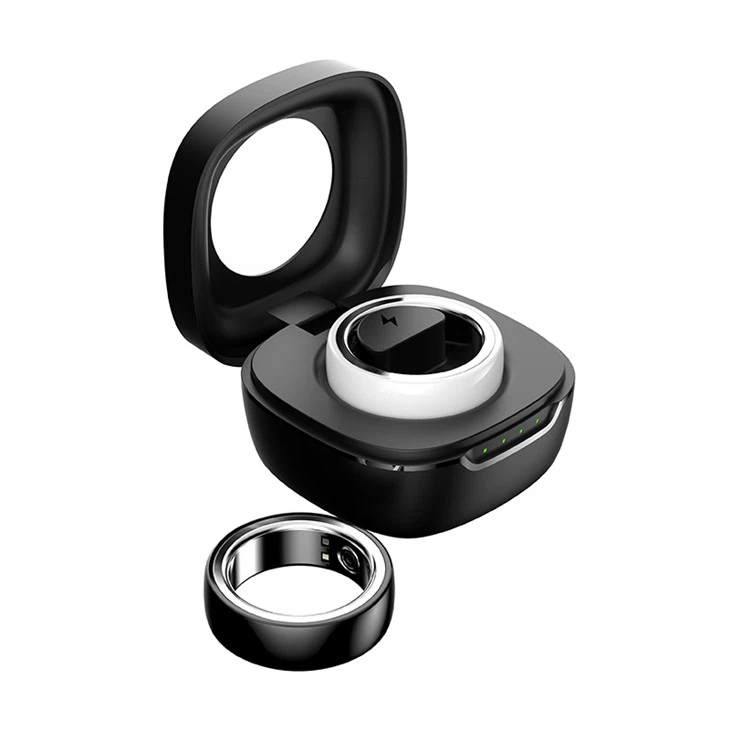

If you're interested in trying out our health tracker smart ring for weightlifting tracking or any other fitness activities, I'd love to hear from you. We're always open to new customers and partnerships. Just reach out to us, and we can start a conversation about how our products can meet your needs.
References
- "Fundamentals of Wearable Sensors for Fitness Tracking", Journal of Fitness Technology, 2022
- "Heart Rate Monitoring in Exercise: Principles and Applications", Sports Medicine Review, 2021
- "Accelerometer - Based Activity Recognition for Fitness Tracking", IEEE Transactions on Biomedical Engineering, 2020


